SMACK is a Dutch artist collective founded in 2005 by Ton Meijdam, Thom Snels and Bela Zsigmond. Using digital animation, 3D techniques and AI tools, they create figurative video works and generative art that explore themes such as digital identity, surveillance, power structures and the absurdities of contemporary culture. Drawing inspiration from classical paintings, SMACK translates the tradition of crowded allegorical painting into animated digital environments populated by hybrid figures and symbolic architectures. Their large-scale installations and films have been exhibited internationally, including at the National Gallery of Victoria Triennial (Melbourne), Matadero Madrid and KIAF Seoul. Their monumental digital triptych SPECULUM, developed with Coleccion SOLO, is part of the permanent collection of the National Gallery of Victoria. In this conversation, the SMACK team discusses their project "Towers," which is powered by Runway's tools.
Can you tell us more about yourself and your background?
SMACK was founded in 2005. We met while studying at art school in the Netherlands and began working together soon after. With a common interest in moving pictures and a hunger for experiment we started exploring digital media in a broad sense.
Since then we have developed a body of work centered on large-scale animated scenes and video installations. Our work often depicts layered landscapes filled with characters and symbolic architecture that reflect society.
From the beginning we balanced personal projects with commissioned work, using both to develop our visual language and technical approach. In 2017 we began collaborating with the Madrid-based art space Coleccion SOLO, which collects and exhibits contemporary art and supports artists working across disciplines.
The theme that runs like a thread through our work is branding. In our earlier work the focus was often on the branding of products and ideas; more recently it has shifted toward the branding of the self. The characters that inhabit our landscapes function almost like logos of identity -- symbolic reflections of ego, imagined versions of how people see themselves.
The "Towers" projects are a really fun exploration of Runway's tools. Can you tell us more about the concept?
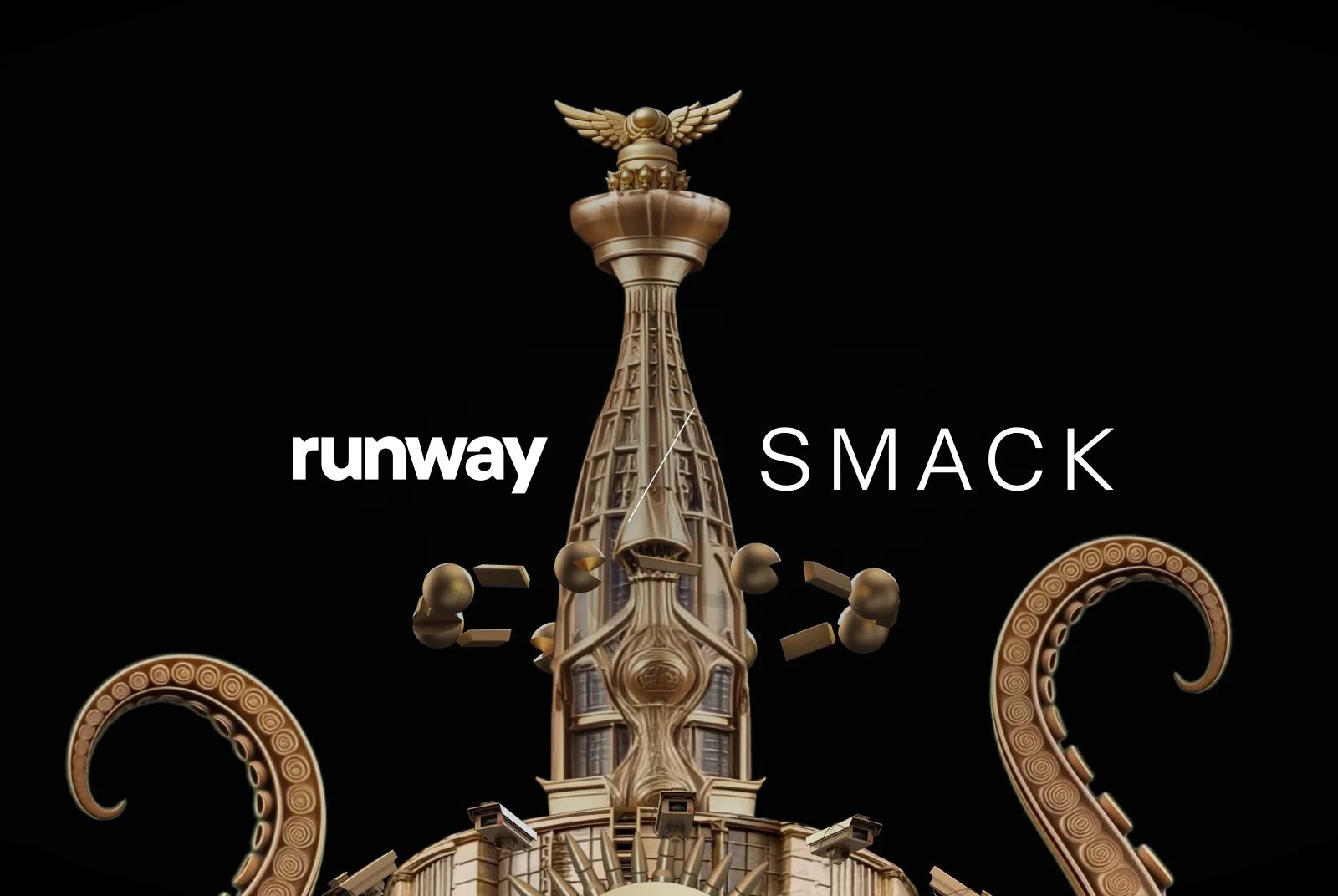
Looking at our earlier works, tower-like structures are a recurring motif. Historically, towers are linked to institutions that shape collective behavior -- church steeples, watchtowers, monuments or corporate headquarters. They rise above their surroundings and signal authority. Because of that, they work well as symbols for systems of power and belief.
In the Towers project we use this form to explore dominant forces in contemporary society. Each tower represents a different force, such as wealth, technology or individual freedom translated into architecture. The towers present these systems as complex environments filled with characters, symbols and small scenes that reflect the values and contradictions within them.
In that sense the towers function somewhat like contemporary allegorical paintings. Artists such as Hieronymus Bosch and Pieter Bruegel the Elder created images where many events unfold at the same time. We approach the towers in a similar way, but in an animated digital form that allows viewers to keep discovering new details.
Each tower focuses on a different system: The Gilded Baron explores wealth, power and control; The Fire Thief reflects how technology is shaping society today; and the tower we are currently developing looks at how the idea of freedom has shifted from a shared ideal to a more fragmented and individual pursuit.
Tell us about your creative process -- how did you come up with your ideas, and how did Runway's tools play a role in shaping your workflows?
In a broad sense, our ideas come from observing what is happening in the world. We do quite a bit of research and draw inspiration from cultural developments, especially digital culture. For this series we wanted to translate modern belief systems to the shape of a tower, inhabited by an ecosystem of personas that feels like a zoo of identities.
The process begins with sketching characters and structures, often starting with pencil drawings and visual notes. Our work used to involve a long pipeline of sketching, 3D modeling, 3D texturing, animation, rendering and compositing. That process is still there, but tools from Runway have changed how we develop and expand ideas.
Instead of carefully designing every variation beforehand, we can generate large numbers of visual possibilities early in the process. This allows us to explore unexpected character designs and movements much faster.
One of the most interesting aspects is how AI introduces a certain level of unpredictability. Sometimes a generated result reveals an unexpected angle that fits the narrative of the story. These accidental discoveries are then developed further and molded to feed back into the project.
In practice the workflow becomes a hybrid process: drawing, prompting, generating, selecting and refining. Runway allows us to quickly test how characters might move or behave inside the towers, which helps us gradually build these animated environments piece by piece.
You've been using these technologies for a long time now, across multiple projects -- as the technology has improved, what's been unlocked for you when it comes to bringing to life what's in your head?
In the beginning, AI tools mainly helped us generate ideas and images that we could use as references. They were exciting, but also unpredictable and difficult to control. For our work, which often consists of detailed worlds with many characters and architectural elements, consistency is important. Early tools didn't really allow that.
Also, most AI image tools are strong in style but less precise when it comes to content. As a maker you still have to steer the results in the right direction. In the beginning it often felt a bit like taming a beast.
As the technology improved, what became possible was much more control. We can now train models, develop characters and guide the output so that it fits within a larger visual system. That allows us to build worlds that feel coherent instead of producing isolated images.
Another important change is speed. For example, 3D rendering video used to take days or sometimes weeks, but can now be generated in a matter of minutes. That doesn't replace traditional techniques in our workflow, but it allows us to test many variations and discover unexpected directions before committing to a final design. The catch with having so many variations is that there is a lot of material to choose from. Hand-picking and organizing that material to create a meaningful composition has therefore become a more prominent part of our workflow.
What's been unlocked for us is not just efficiency, but the ability to explore more complex worlds. Runway allows us to move faster between imagination, experimentation and production, which makes it easier to bring large, layered ideas to life.
How did you work with Runway's tools to get the specific look you wanted, especially the consistency?
Consistency was important for us because the towers are built from many separate parts that eventually have to function as one image. Each element, character, architectural element and object is created individually and then assembled into the larger composition.
In the beginning we used a combination of Runway, other AI models and our own trained models inside Krita (an open source alternative to Photoshop) to generate these elements. Different tools were needed for different tasks, and we often moved between them to get the right look. As Runway's models improved, and they began incorporating strong third-party models, more of that process gradually shifted into Runway itself. At this point we do most of the generation and iteration within one environment.
Images created with models like Gen-4 and Nano Banana Pro helped us establish the visual language for characters and architectural details. Once those elements existed, we used Runway's video models Gen-4 Turbo and Gen-4.5, as well as Veo 3 and 3.1 within Runway, to generate movement and variations.
AI is combined with more traditional animation tools in the process. Some elements are built or refined in Cinema 4D and animated or composited in After Effects. Every character or object is designed as an animated loop. When assembled into this digital collage, the result is an "altarpiece" in constant, shifting variation.
How has AI changed your approach and style when it comes to making digital art?
AI hasn't fundamentally changed the themes or ideas in our work, but it has changed how we approach building images. Our practice has always focused on constructing complex visual landscapes. AI has made it easier to develop these kinds of environments by allowing us to generate and test visual elements much more quickly.
It has also shifted the process toward working in smaller components. Instead of designing a whole scene at once, we often develop characters, objects and architectural fragments separately and assemble them later. AI works well with this modular approach because it allows us to produce many variations of individual elements and refine them before placing them into the larger composition.
At the same time, the process has become more exploratory. AI often produces unexpected combinations of forms, textures or gestures that we wouldn't have designed ourselves. Some surprises can lead to new visual ideas or characters that become part of the final work.
What's next for you -- what other projects do you want to create?
The Tower series is an ongoing project. We initially envisioned three towers, but the structure of the project makes it possible to expand to five or even more. We are also interested in how the towers function together, both in exhibition spaces and potentially within shared digital environments.
At the moment we are working on the third tower, which explores contemporary ideas of individual liberty and how the concept of freedom has shifted from a collective ideal to a more fragmented and personal pursuit.
At the same time, the rapid development of AI tools continues to influence how we work. The technology is evolving at an incredible pace, constantly opening new possibilities for how we develop and produce these worlds.