Bentley Systems is a global company building software for infrastructure development and engineering. Their products are used in many of the world’s largest physical builds, including data centers, airports, bridges and railroads. Bentley Labs is the company's internal R&D skunkworks: a small team of hackers, designers and engineers whose job is to prototype the future, then bring it to life at events and summits where investors, clients and press come to see what's possible. In this conversation, Bentley Labs’ creative technologists discuss how they used Runway to bring some of their latest work to life at ATN Summit.
Tell us a little about what Bentley Labs does and how you fit into the broader company.
Bentley has been building infrastructure software for more than 40 years. Our customers are the people designing the biggest bridges in the world, the longest roads and the most complex rail projects happening right now. The software has to be incredibly precise and accurate. What we do at Labs is prototype the future – we look at what's happening in the world, identify the technologies worth exploring and figure out how to integrate them into our platform. Unreal Engine is a good example: we took a game engine, brought it into our visualization pipeline and it's now part of our core software portfolio. That same spirit drives everything we do.
We also spend a lot of time at events—trade fairs, our own summits—showcasing what we're building to investors, VIPs, press and clients. We're often working with large-format LED walls, immersive rooms, projection scrims. It's a real production.
What was the project that first brought you to Runway?
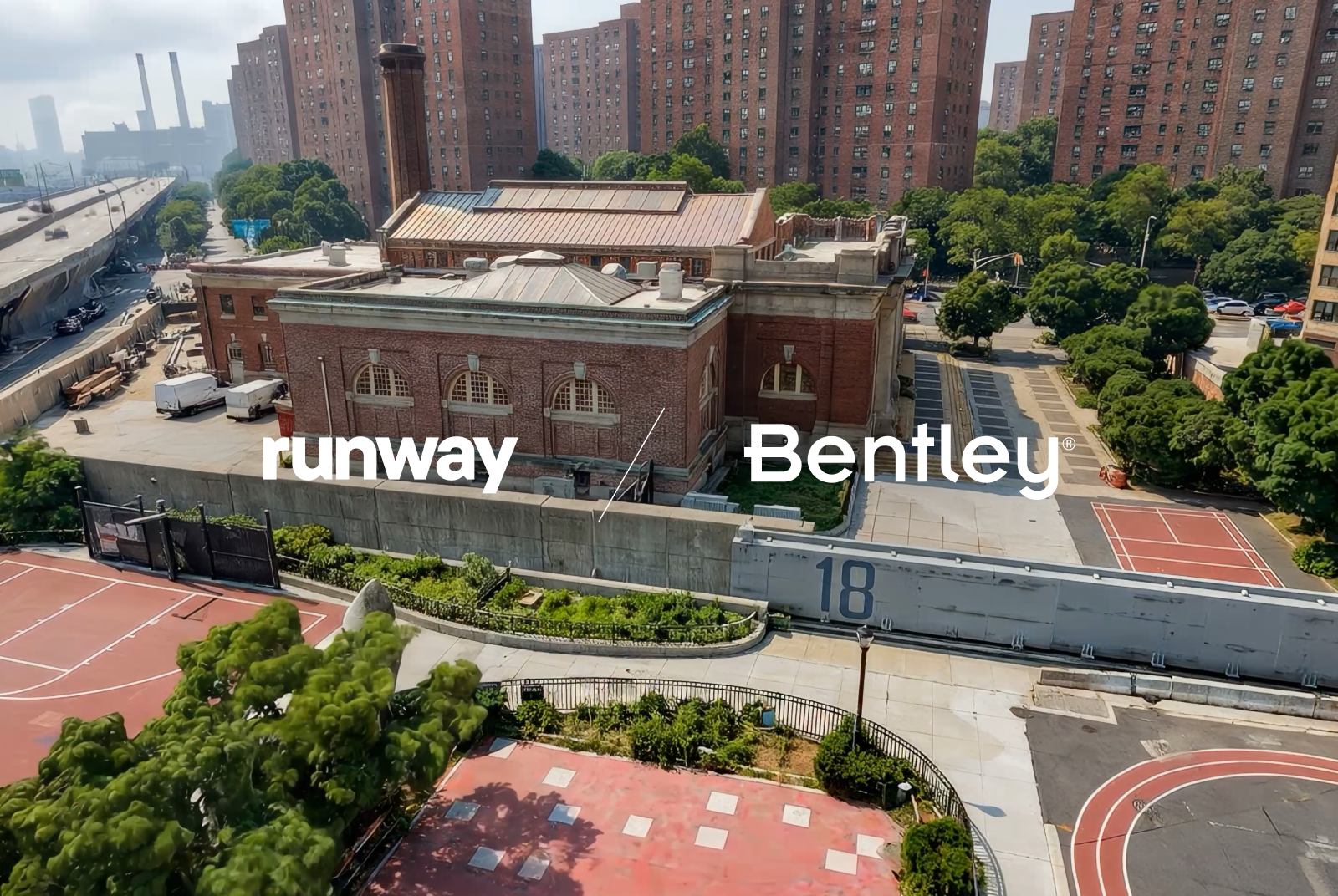
We were part of the ATN Summit in London, which is a large conference focused on architecture and technology. There was real hunger in the engineering and architecture world for this kind of gathering. We had a dedicated immersive space where we wanted to tell the story of New York's Floodgate Resilient Project, which is the infrastructure that's meant to keep Manhattan dry during major storms like Hurricane Sandy.
We collaborated with Aaron Huey, a photographer and new media artist, who went and physically captured the floodgates. He could only scan them while they were open, which is how they exist day-to-day. The challenge was showing people how they actually work: closing as a storm approaches, holding back floodwater, protecting the control infrastructure that keeps the city running. We had Gaussian splats, we had 3D models rendered in Unreal Engine, we had still photographs from the architects – but almost no video footage. Runway solved that problem.
Walk us through how you actually built the content.
We had a few different workflows running in parallel. We used Runway to animate the architectural images we'd received from the design team. Some were quite blurry or low resolution, but we could still get compelling motion out of them. Those animated sequences gave us the ability to fill out the full runtime of the film in a way that wouldn't have been possible otherwise.
The more technically interesting workflow was around the floodgates themselves. We loaded the Gaussian splats into Unreal Engine and brought in Google 3D Tiles for citywide context. The issue is that Google's 3D tiles look great from a bird's eye view, but at street level they have this melted plastic quality. So we used Runway's first-and-last-frame animation to bridge the gap between what we had and what we needed to show. We'd take the splat of the gate in its open state and use Runway to create high-quality video footage of the gate closing. Then, we used Runway to create that same scene with variations on the weather: stormy, then flooded over time. We chained those transitions together into a full video sequence showing the gates in action.
We also took 3D model screenshots of a control room scene from Unreal Engine and used Runway to flood it virtually. The client who owns that infrastructure actually reviewed the footage with us. Their feedback was that the water looked too dramatic, too much debris on the surface. And right there in the meeting, we were able to iterate in seconds: remove the surface particulate, keep everything else. That kind of real-time responsiveness to client feedback would have been impossible with a traditional production pipeline.
How did attendees respond?
Absolutely blown away. We had significant inbound afterward – new connections, partnerships, the kind of conversations that only happen when people see something they haven't seen before. We had a full film crew on-site to document everything, and we've since published blog posts and additional videos from the event. We're already working on the next one, this time in Berlin.
What advice would you give to other architecture or engineering firms thinking about using AI video tools?
The versatility is the thing people don't fully appreciate yet. It's not just "animate this render." You can generate 3D textures, create water surfaces, upgrade low-fidelity screenshots into something presentable – the tool set is wide. I'd encourage firms to look for inspiration around what else is possible, because most people are just scratching the surface.
What's next for Bentley Labs with Runway?
We're constantly generating new ideas. We're working with Apple Vision Pro and exploring video-to-3D pipelines. The floodgate project showed us that Runway isn't just a post-production tool – it's part of our live client workflow. That changes how we think about it entirely.