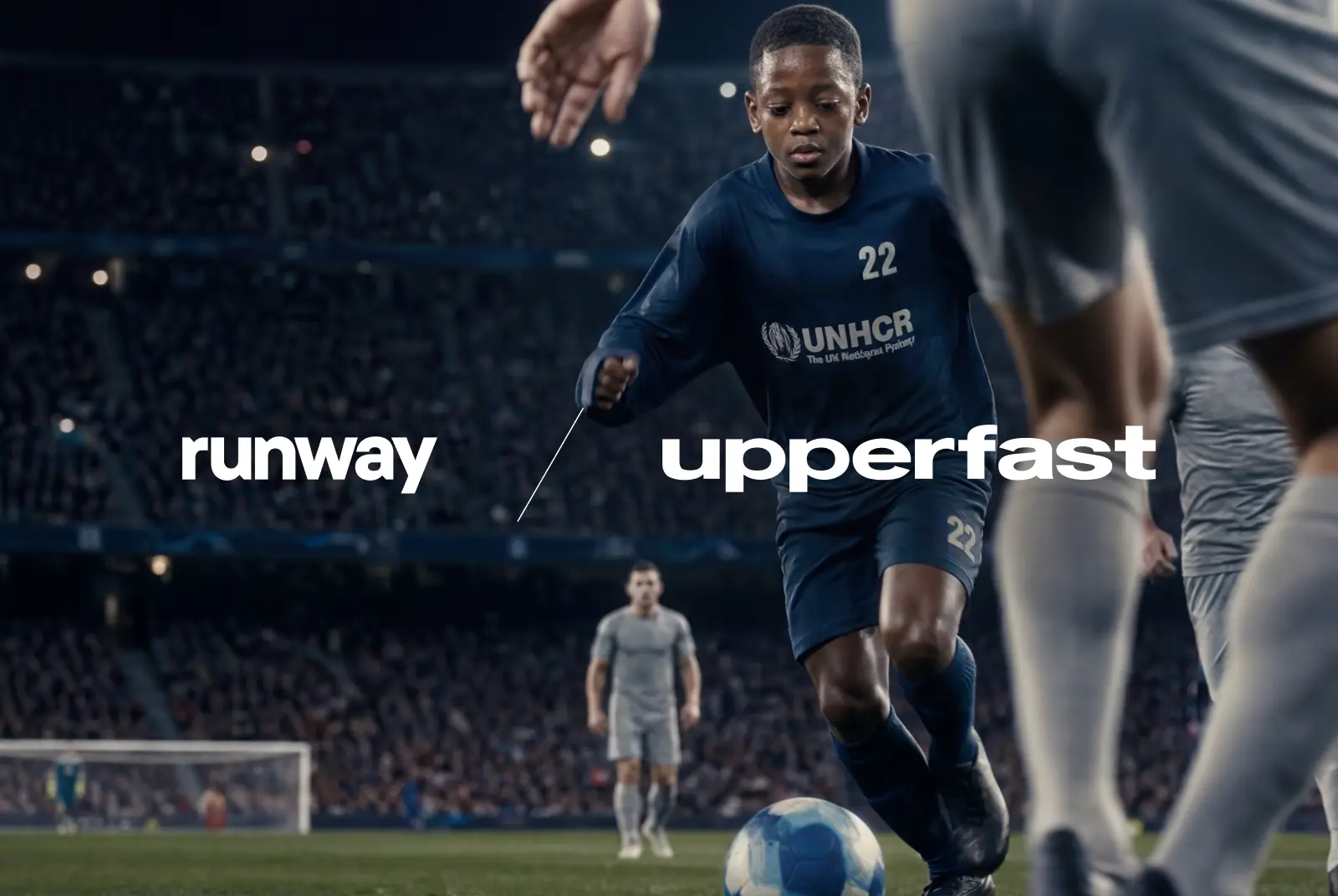
When production company ground6 and director upperfast teamed up with UNHCR, the UN Refugee Agency, the mission was both simple and profound: show that displacement doesn't cancel out potential.
A traditional shoot would require coordinating professional footballers schedules across Madrid, London, Australia, and more flying crews to multiple continents and a budget no NGO could justify. So ground6 built an AI-powered pipeline using Runway. The resulting film generated 1.2 million organic views in its first 24 hours, screened at the UN General Assembly in front of world leaders and the President of FIFA and is now on permanent display at the UN building in New York. In this discussion, the upperfast creative team tells us how they did it.
Tell us about the brief and how the concept came together.
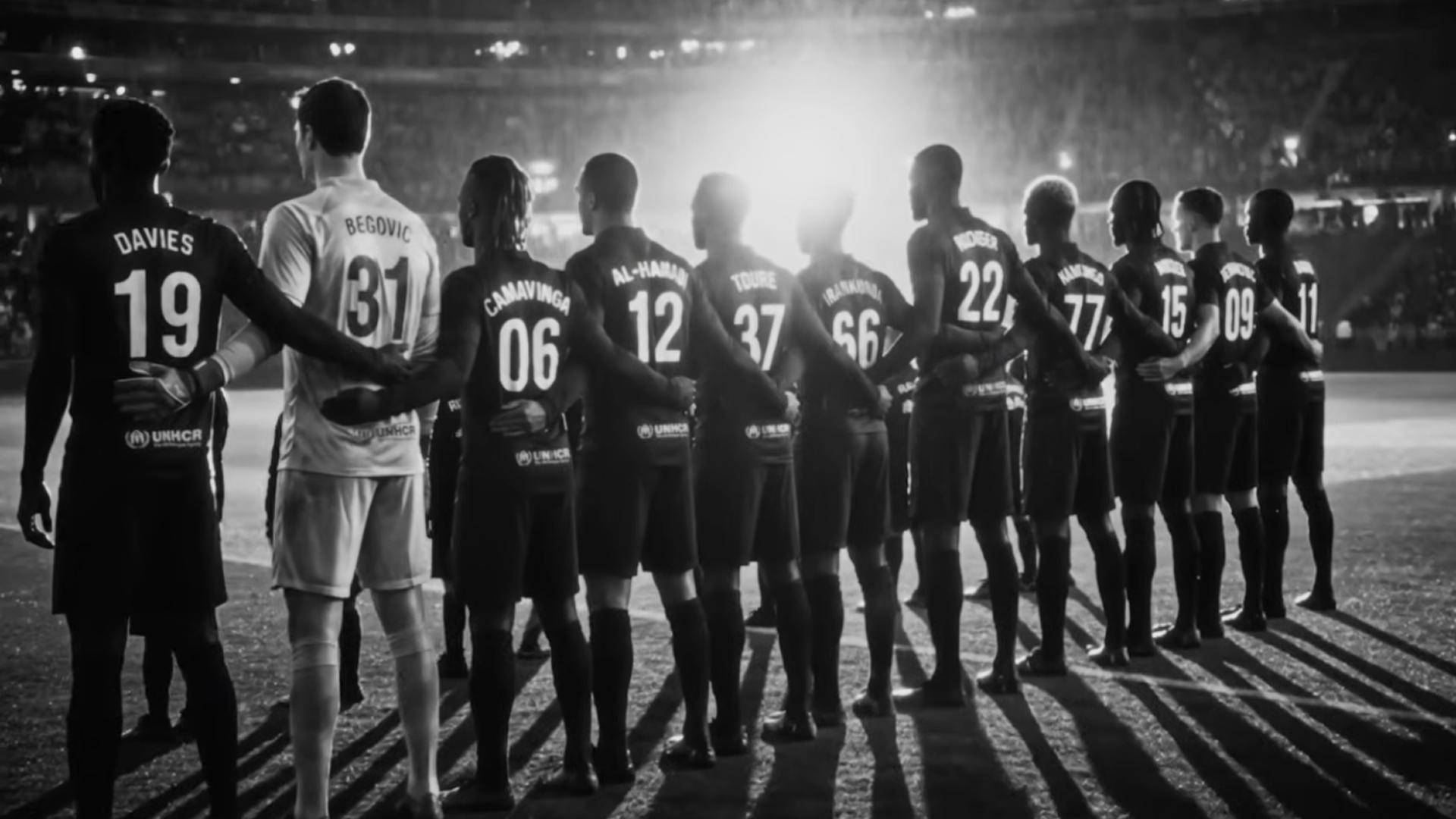
We have a strong ongoing relationship with UNHCR and they came to us wanting to do something for the World Cup. They have a variety of ambassadors — including Alphonso Davies, Antonio Rüdiger and Eduardo Camavinga — all players with backgrounds shaped by displacement.
Once we had the concept, the next question was how. Lining up eleven professional footballers' schedules, traveling to where they train, getting clearance, and finding child likenesses that matched their actual stories – that would never have been possible through traditional production. Three years ago, this film simply doesn't get made.
How did you approach recreating the players as children with authenticity?
This was the central challenge of the whole production. We started with intensive archival research – old photos, web archives, anything we could find. For most players, that gave us a solid foundation to work from.
There were one or two cases where players simply didn't have childhood photos. Because of displacement, those memories — even physical ones — didn't exist for them. Which made the responsibility of getting this right feel even heavier.
What did the actual production pipeline look like?
We built custom tools that connected fine-tuned LLMs with diffusion models, designed so that our creative team, beyond our technical specialists, could use them. That was important to us. In the past, teams may have worked with VFX experts on one side and a creative director on the other, and the translation between them usually produced something technically correct but creatively flat.
For this project, six or so people were actively working in the AI pipeline, with two dedicated AI artists doing the heavy lifting on shot execution: making sure pieces like the jersey colors were right, the likeness held, the transformations landed. We used Runway for all video inference, and without Runway being as professional and stable as it was, we would have had a serious problem.
Why Runway specifically?
Part of it was just that it works. When you're in production and you need results, stability matters more than any feature list. But there's something else I always notice about Runway that I appreciate: it's clearly built for professional use. There are no gimmick-of-the-week features, no credit discount schemes designed to get you to invite friends. You pay for credits, you get the full power of what's available and you use it.
The group feature was particularly useful for this piece because it enabled everyone to generate simultaneously and see what each other was working on. When someone found a good seed or a prompt that was working, we could share it immediately. That kind of collaborative visibility matters when you're iterating fast under deadline.
You also took the final digital video and printed it on 16mm film – tell us about that decision.
Yes, once we had the film locked in, we transferred the finished film to 16mm and then scanned it back to digital. As far as we know, we are the first people to have done this with a purely AI-generated film, but it felt right.
The models are extraordinary – they produce a certain kind of perfection. Everything is sharp and clean. But this hyper-precision reads as digital, and we wanted to bring back imperfection to the story. Printing to film brought in grain, imperfection and organic texture — the kind of small artifacts and subtle noise that we wanted to add. Marrying the two mediums felt like the right way to honor this story we were trying to tell.
The film reached 1.2 million views in 24 hours, and screened at the General Assembly. How did that feel?
There's a version of impact that's measured in views and then there's another version that's measured in who sees it – and we felt really lucky in both departments with this one. Many of the players shared it directly with their audiences via their own channels and communities. And by showing it at the UN General Assembly, we were able to get in front of leaders who have a real voice in what happens to displaced people around the world.
One piece we found meaningful in telling this story is how technology made it possible – not by replacing the creative process, but by removing the budget ceiling from it. Purpose-driven organizations like UNHCR no longer need a feature-film budget to tell bold, emotionally resonant stories at scale. Used with care and craft, AI can put that kind of storytelling within reach of the causes that need it.
What's your broader take on where AI fits in the creative process?
People still think you press a button and a finished film appears. The more we use these tools we know this is not true.
We used to walk into brainstorms and quietly censor ourselves. If the budget is X and the timeline is Y, certain ideas just don't get voiced. Now we catch ourselves thinking: hold on, this might actually be possible with AI. That shift — from self-editing before you even start to allowing yourself to have the idea — is the most significant thing that's changed in how we work.