Crossing the Uncanny Valley of AI Media

Project Luxo

Today we’re sharing early evidence of a shift we believe will reshape how media is made: AI-generated video has crossed the uncanny valley.

For the past several years, AI media has been defined by its artifacts. Viewers noticed the strange eyes, the drifting faces, the unstable characters, the imperfect lip sync, the unnatural motion and the small inconsistencies that made otherwise impressive generations feel emotionally distant. The work was often remarkable, but the technology remained visible.

That is beginning to change. We believe AI models have reached a level of visual realism, temporal consistency and creative controllability where they can now support stories that do more than demonstrate technical capability. They can help to tell stories that hold attention, generate emotional investment and leave viewers responding to the work itself rather than only to the systems that were used to produce it.

This is an important threshold for AI media. A medium matures when audiences stop evaluating the tool and start engaging with the story. We are now seeing the first clear signs of that transition.

To better understand this shift, we showed three fully AI-generated short films and a spec ad to a wide range of people across the creative ecosystem, including producers, actors, guild members, studios, press, talent, community organizations and other industry participants. We asked them to evaluate the films on emotional resonance, whether they felt hooked, emotional investment and overall story.

The results were clear, every one said the same thing: the films worked.

The films were not perfect. AI media is still developing quickly, and many challenges remain. But the response suggests something meaningful: the artifacts are no longer the dominant experience. In many cases, if the story is strong enough, the technology is now good enough to become invisible.

That is what crossing the uncanny valley looks like.

The Rogue (9:57)

Production Timeline: 3 Weeks

Team Size: One Person

A harrowing story of loss set at sea as two young boys confront impossible conditions and constant danger.

Warning: The following video contains scenes that may be distressing to some viewers

Last Night (5:28)

Production Timeline: 7 Hours

Team Size: One Person

An intimate look at the last night of a relationship. Meant to reflect the feeling of reliving the fragments of a monumental moment through memory alone.

Pigeons in Time (0:46)

Production Timeline: 4 Hours

Team Size: One Person

A short segment pulled from a longer short capturing the moment three pigeons stumble upon something that will thrust them into a new world.

AI media and the uncanny valley

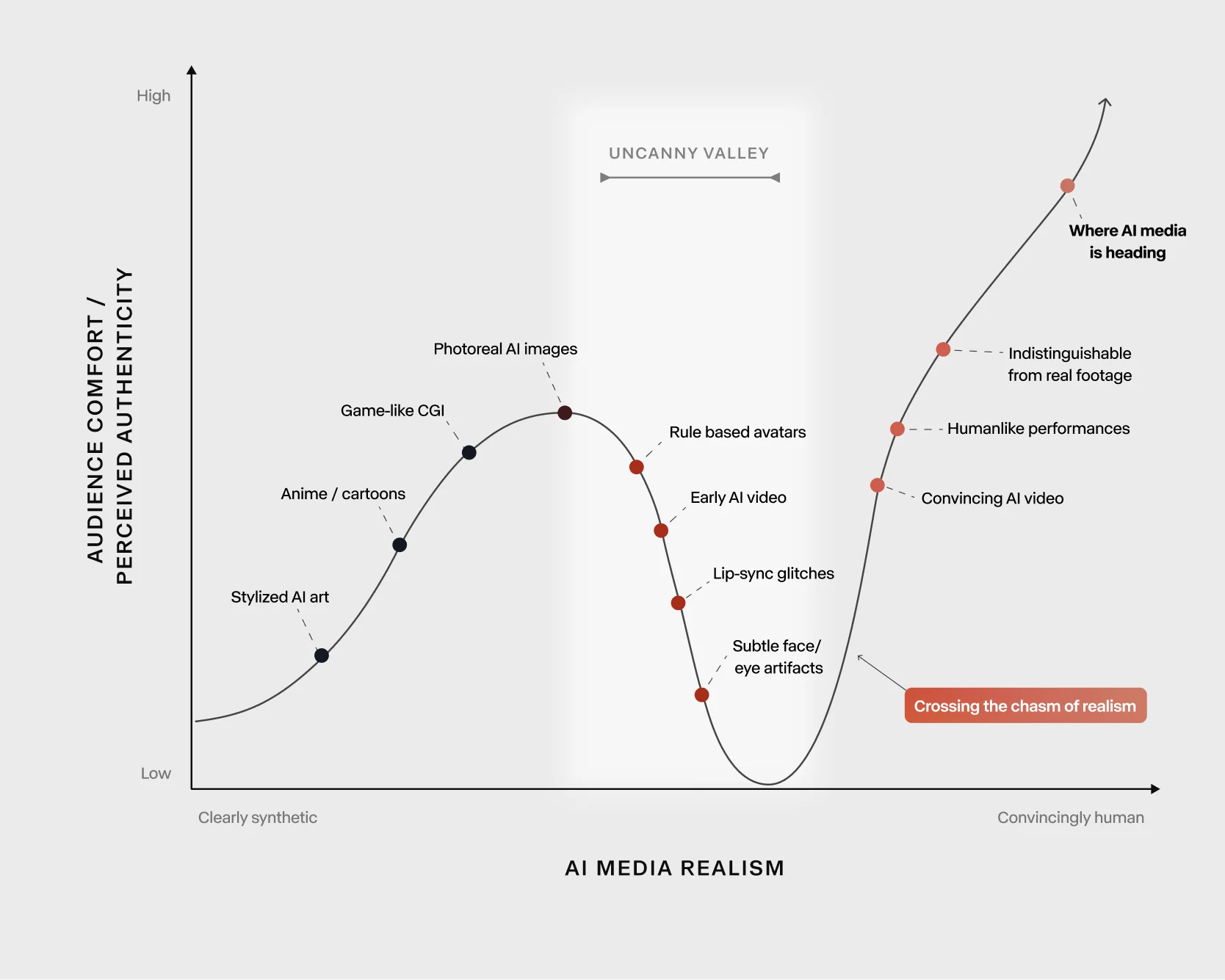
The uncanny valley describes the point at which synthetic media becomes close enough to human reality that its flaws become unsettling.

When media is clearly artificial, audiences tend to accept it easily. Stylized AI art, animation, cartoons, anime, surreal imagery and game-like CGI do not need to pass as reality. Their artificiality is part of the form. Viewers understand the contract immediately.

The difficulty begins when AI media approaches realism. A face can look almost human, but the eyes may feel wrong. A performance can be almost believable, but the expression may not match the moment. A mouth can almost sync to speech, but the timing may slip. A character can hold together for one shot, then subtly change in the next. These small failures matter because they interrupt emotional trust and take you away from the underlying story.

For much of the last generation of AI video, this was the central limitation. The work could be visually impressive, but the viewer was still watching for the mistakes. The technology was not invisible enough for the story to fully take over.

As AI video improves, those failures become less frequent, less distracting and less central to the experience. Characters hold together for longer. Performances become easier to read. Shots connect with greater consistency. The world feels more stable. The viewer can stay inside the film.

This does not mean the uncanny valley has disappeared. It means we are beginning to move through it.

Uncanny valley chart
Chart: The Evolution of AI Media. Made by Runway, 2026.

The Storytelling threshold

The most important test for AI media is not whether it can produce an impressive shot. It has been able to do that for some time. The harder test is whether it can sustain emotional attention.

A single beautiful image is not a film. A striking clip is not a story. A technically impressive generation is not the same as a compelling experience. Stories require rhythm, character, pacing, tone, continuity and emotional shape. They require the viewer to care about what is happening and to keep watching because they want to know what comes next.

That has been the last mile of AI media. The last mile is not only graphics. It is consistency in service of story. It is the point at which the model stops being the subject of the experience and becomes part of the production process behind it.

There is a useful historical comparison in Luxo Jr., the short film Pixar showed at SIGGRAPH in 1986. The film was a technical breakthrough, but its significance was not only technical. People responded to the lamp as a character. They noticed timing, personality, humor and feeling. The achievement was not simply that a computer could render an object. It was that computer animation could support performance.

We believe AI media is approaching its own Luxo Moment.

The question is no longer only whether AI can generate realistic footage. The question is whether AI-generated footage can support emotionally legible stories.

The answer, increasingly, appears to be yes.

What We Tested

We screened three AI-generated short films and a spec ad for a broad set of viewers across the media and entertainment ecosystem.

These audiences included people who understand the many layers that make media work: production, performance, writing, distribution, talent, audience response and the cultural implications of new creative tools. We wanted to understand whether the films worked as films, not only as demonstrations of model capability.

Across these dimensions, the response was strong: 93% of viewers said the short films worked.

That result matters because it points to a change in how people are experiencing AI-generated media. The viewers were not only asking how the films were made. They were responding to what the films were doing.

They were following the stories. They were reacting to the characters. They were evaluating pacing, emotion, tone and payoff. In other words, they were watching the films as media.
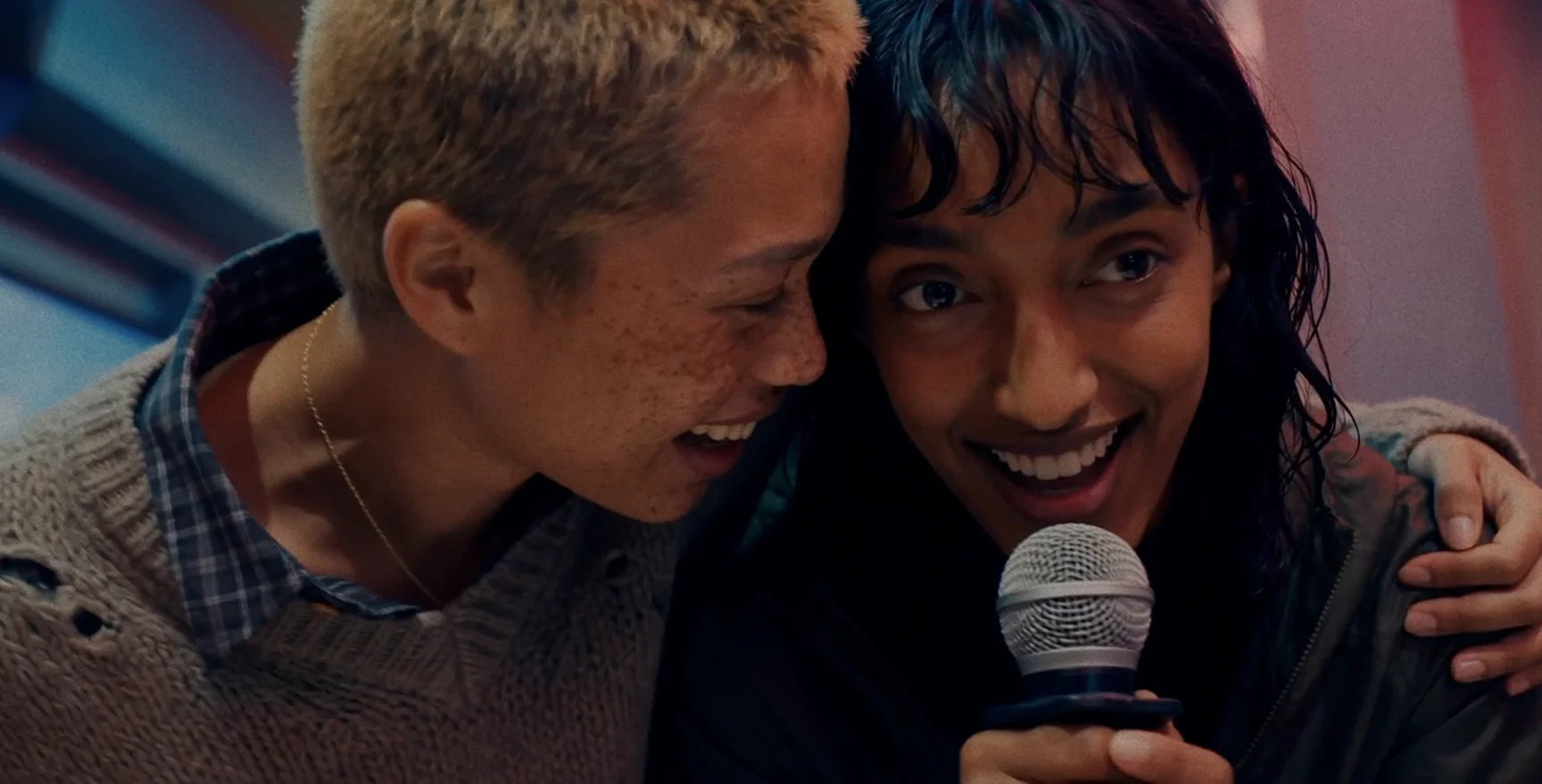
What Changed

Over the past year, AI video models have become substantially better at the qualities that matter most for narrative work.

The first wave of AI video was defined by surprise. It could create images and clips that felt impossible a few years earlier. But these generations often broke down when creators tried to build stories from them. Characters changed. Environments shifted. Motion failed. The model introduced noise into moments that needed precision.

The latest generation of tools is beginning to change that. The improvement is not just higher visual fidelity. It is greater consistency, more predictable control and a stronger ability to preserve the emotional intent of a scene.

Each short was made by one person in as little as a few hours to a few weeks of work. We estimate the total cost across the films was around $4,000.

It does not remove the need for taste, judgment, writing, direction, editing or craft. In many ways, it makes those skills more important. But it dramatically lowers the cost of attempting a visually ambitious idea.

A single creator can now build a short film with cinematic images, designed worlds, consistent characters, visual effects and emotional pacing at a level that would previously have required a much larger team and budget.

This does not mean traditional production goes away. It means the boundary of who can participate in cinematic storytelling expands.

That expansion is one of the most important consequences of this moment.

The Social Proof

On April 13th, we posted a short spec ad for a fictional watch brand. In 48 hours, it amassed over 100 million views on Instagram alone. Reposted countless times by major accounts (with no mention of AI), the ad reached all pockets and audiences of the internet. With the conversation driving entirely around the narrative power of the piece. And in the few instances where AI was mentioned, commenters were quick to question what that had to do with anything. People were watching for the story. Not the technology it was created with..

It is clear. A good story told with AI is a good story. We are moving through the valley.

Instagram engagement metrics for the watch ad

What Comes Next

Crossing the uncanny valley does not mean AI media is complete. There are still open questions in realism, control, consistency, performance, authorship, rights, consent, labor, disclosure and creative responsibility. The medium will need new norms, new workflows, and new standards. The industry will need to keep asking hard questions about how these tools are built and the safety standards with which they're used.

AI-generated video can increasingly support stories that people care about. It can create emotional resonance. It can hold attention. It can make viewers invest in characters and worlds. It can allow a single creator, working over a short period of time and with a small budget, to make something that reaches an audience. It's an incredibly exciting time to have a story to tell. We're proud to be partnering with artists, creatives, studios and brands to help them tell theirs.

Share Project Luxo