We recently launched Runway Agent 2.0, built to help users turn a single idea into finished creative without losing control of the process along the way. It's grounded in a core idea: build around the work people are actually trying to do.
To get a behind-the-scenes look at building Agent, we sat down with members of our product and engineering teams, Aditi Poduval and Kristian Muñiz, who shared a bit more on the intention behind the product, how it’s transforming creative work end to end and what’s on the horizon for Agent.
What was the inspiration behind Agent? How did it come to be?
Aditi Poduval: Our mission at Runway has always been to democratize storytelling: making it accessible to people without a professional studio behind them or formal training. Agent was born out of asking what that looks like in a new medium: agentic, multi-shot video creation. You might have a clear idea, but not always the creative language or technical expertise to share it with the world, and we wanted Agent to be a partner you can actually talk through an idea with. It started around video specifically, and it’s grown into something that supports a much broader range of storytelling and creative work.
It’s also not just about creating a single clip. You can bring video clips, audio and images together into one timeline directly within the interface. That means you’re moving beyond a singular output and toward fully finished videos right inside Agent.
What kinds of problems are you trying to solve with Agent?
Kristian Muñiz: Generating media and knowing what makes a good film, an interesting script or a strong piece of media are two different things. That judgment comes from people who understand craft, which is something our in-house team of technical artists has deep expertise in. A big part of building Agent was figuring out how to build that judgment into the system, on top of what the underlying models can already do. We keep iterating on it as we learn more, and Agent is designed to present options and variants. That way, it’s always in service of the same thing: keeping creative control with the user.
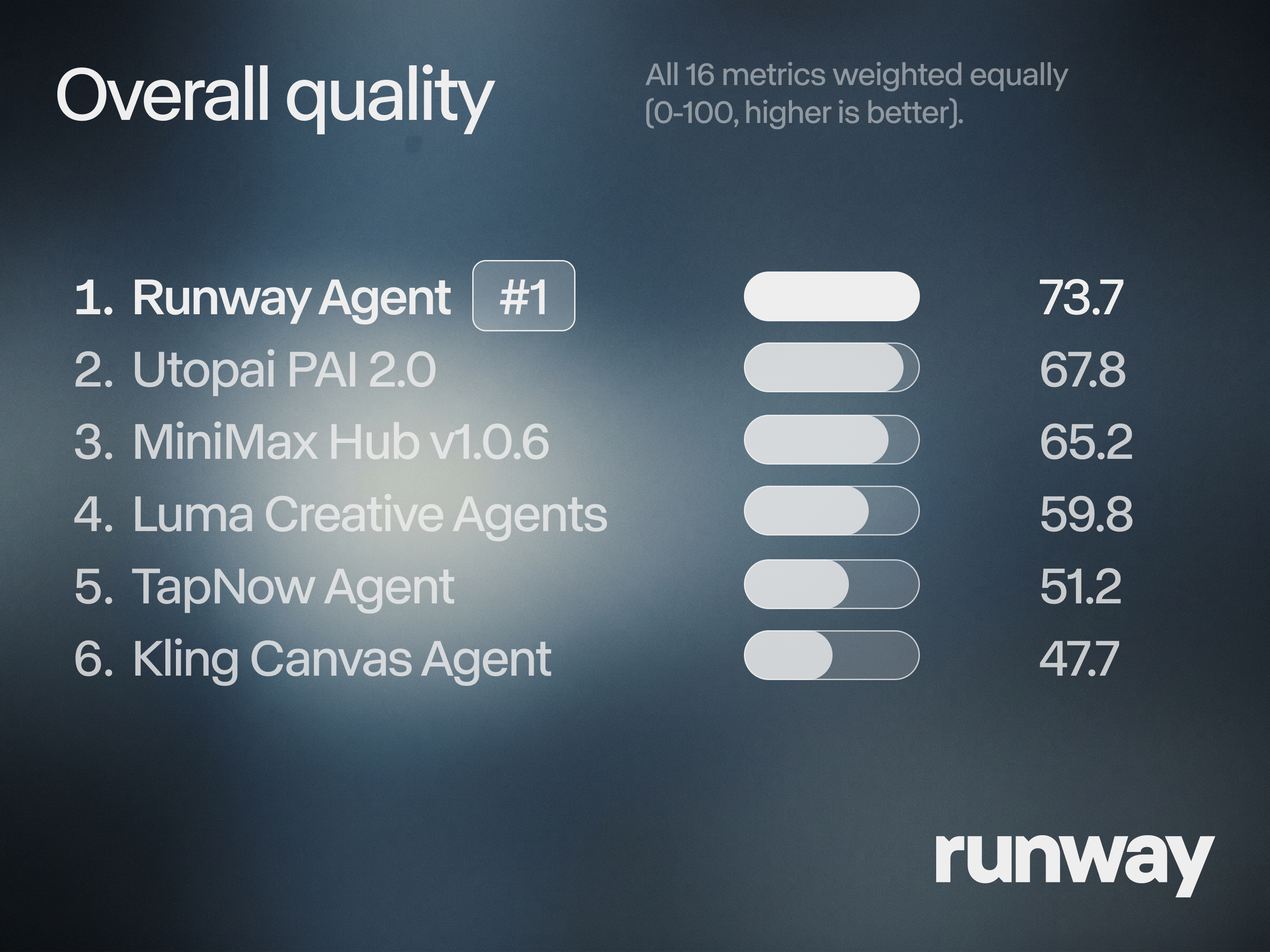
We’re seeing this resonate in the market, too. Physion Labs, an independent evaluator of AI video agents, ranked Runway Agent 2.0 first among six agents in its Arc 1.0 benchmark, which is especially meaningful because it validates areas we’ve been deeply focused on, including cinematic quality, coherence and trust and safety.
Who is Agent really for?
Poduval: Agent is especially powerful for people who have a clear vision for an outcome but may not have all the tools to get there. That's why Agent is particularly well suited to marketers. Whether it’s building social content, generating ad variants for testing or working toward a specific campaign goal, Agent is your creative partner.
It's just as useful for people who are starting from something looser: a feeling, a mood, a style they're drawn to and want help brainstorming from there. No matter your starting point, Agent helps you get to something that matches your vision. The audience extends well beyond marketing too. It's useful for cinematic creation, for turning existing content into video or image-based storytelling and for people exploring broader creative workflows inside Runway.
Tell me more about how Runway’s in-house creative expertise shaped Agent.
Poduval: What sets Agent apart is how deeply our creative team was embedded in building it and actually shaping product decisions from the start. Ian Sansavera was a key champion of many of the details that shaped the experience. He's constantly prototyping and tinkering, and he’s a true workflow expert, building both the apps and the prompts that bring those workflows to life. That kind of hands-on creative expertise built into the product is a big part of why Agent understands what separates strong creative work from the rest. And this type of collaboration reflects the spirit of how we build products at Runway.
On the technical side, how does Agent actually support that iterative process?
Muñiz: Agent has encoded knowledge about the strengths and weaknesses of different models: which ones render motion well, which hold up better for photorealism, which are faster but less precise. No single model is best at everything, so the system needs to understand which models are better for different types of media and tasks. On top of that, there’s also a skills layer: the ways of combining those capabilities into useful strategies and workflows.
Underneath all of it, Agent actually understands what it’s helping create. It knows how to generate a clip and what makes it work in a short film, an ad or a campaign. That's what lets the interaction become about asking the user the right questions and helping surface different paths they can take based on their goal.
What makes Agent especially useful for visual storytelling?
Muñiz: We believe storyboarding is an important step in the process of making sure your output matches what's in your head, and the Agent interface was intentionally designed as a visual-first experience to make that possible. If you ask it to generate 25 images in different styles, it doesn’t just return a list in a chat. It presents them visually, front and center, so your focus is always on the output first and foremost. From there, you can react to what you’re seeing, say what you like, discard what you don’t, drag something back into the chat and take the conversation in a new direction.
Poduval: The question-and-answer process helps people refine their ideas iteratively so they can get to a stronger foundation. One of the interesting things we’ve learned is that many people don’t necessarily come with a fully formed description. They often know the goal, but need something visual to react to before they can refine it. It’s not just a text-based iteration process; it’s a visual one, too.
You mentioned that Agent isn’t just about one-off generation. How do you think about the broader way it can support creative work?
Poduval: Agent is, of course, highly capable at generating media, but we see it as a much broader way to complete end-to-end creative work. You don’t just stop at the media itself. You can bring in all kinds of inputs — performance data, market context, a creative brief — and use those to shape the story, the messaging and the execution inside the same experience.
For example, you can upload a PDF with your latest ad performance results and ask Agent to analyze it. It will propose a new strategy or brief based on what it finds, then create the actual creative from that brief.
Are there best practices for using Agent in an end-to-end workflow?
Poduval: It can work for both kinds of users: people who come in with a very clear, detailed vision, and people who need help teasing that vision out. The back-and-forth is part of the value. If you know exactly what you want, Agent can move into execution mode. If you don’t, it can help surface the details along the way. Over time, that also opens up more room for skills and customization so people can shape the kinds of results they prefer and make those workflows easier to repeat.
What makes Runway Agent different from other tools in the space?
Muñiz: For me, it’s the interface. A lot of tools in this space are chat-first, where the conversation is front and center. Agent is much more media-centric. The actual artifact you’re trying to create stays at the center of the experience, and the interface adapts as you work, whether that means surfacing images, showing you a finished video or letting you pull different assets into a timeline and keep building from there. The chat experience is still vitally important, but what you're creating remains the focus.
Agent also carries a real point of view. It's built on the taste of our technical artists, and it's proactive about guiding you to the next step. It’s also multi-modal by design: you can move between agentic generation and manual editing within a single session to get to a finished video instead of switching tools along the way.
Poduval: Another big difference is the way we combine models and make decisions in service of aesthetic quality and consistency. That’s an area we’ve invested in heavily.
Trust and safety is also a big pillar of how we build research products and experiences at Runway. We work in deep partnership with our trust and safety team, thinking carefully about both consumer and enterprise use cases. We're careful about what Agent creates on behalf of a user because we know that's a big responsibility.
Has anything surprised you about how people are using Agent?
Muñiz: One thing that's stood out to me is how many people come to Agent with only a loose sense of what they want to create. It often starts as a short sentence or a general direction, and after some iteration, they land somewhere entirely different from where they began. This kind of fluid exploration has turned out to be a meaningful part of how people use the product.
Poduval: Something I’ve valued most is seeing what happens after the barrier to create comes down. People are consistently surprised by the quality of what they're able to produce. We hear from users who say it feels like they suddenly find themselves able to craft polished, cinematic content. Even on our own team, it’s been gratifying to see people create two-minute videos that are genuinely cinematic and distinct.
What’s next for Agent?
Poduval: Looking ahead, we want Agent to feel less like a tool you brief from scratch every time, and more like a teammate that already knows you. That means leaning further into brand identity, remembering context from previous sessions and drawing on references and creations from both inside and outside Runway, all in service of consistency and quality that holds up project after project. The better Agent understands that context, the more ambitious the work it can take on with you.
Agent is already very aware of the assets you upload and can clearly read different visual styles, which makes it great for creating on-brand content today. We're building on that foundation alongside a few other things: making everyday tasks more repeatable through batch creation, enabling task scheduling directly within Agent and connecting more naturally with other tools people already use.
Runway Agent 2.0 is available for all users. Try Agent today →