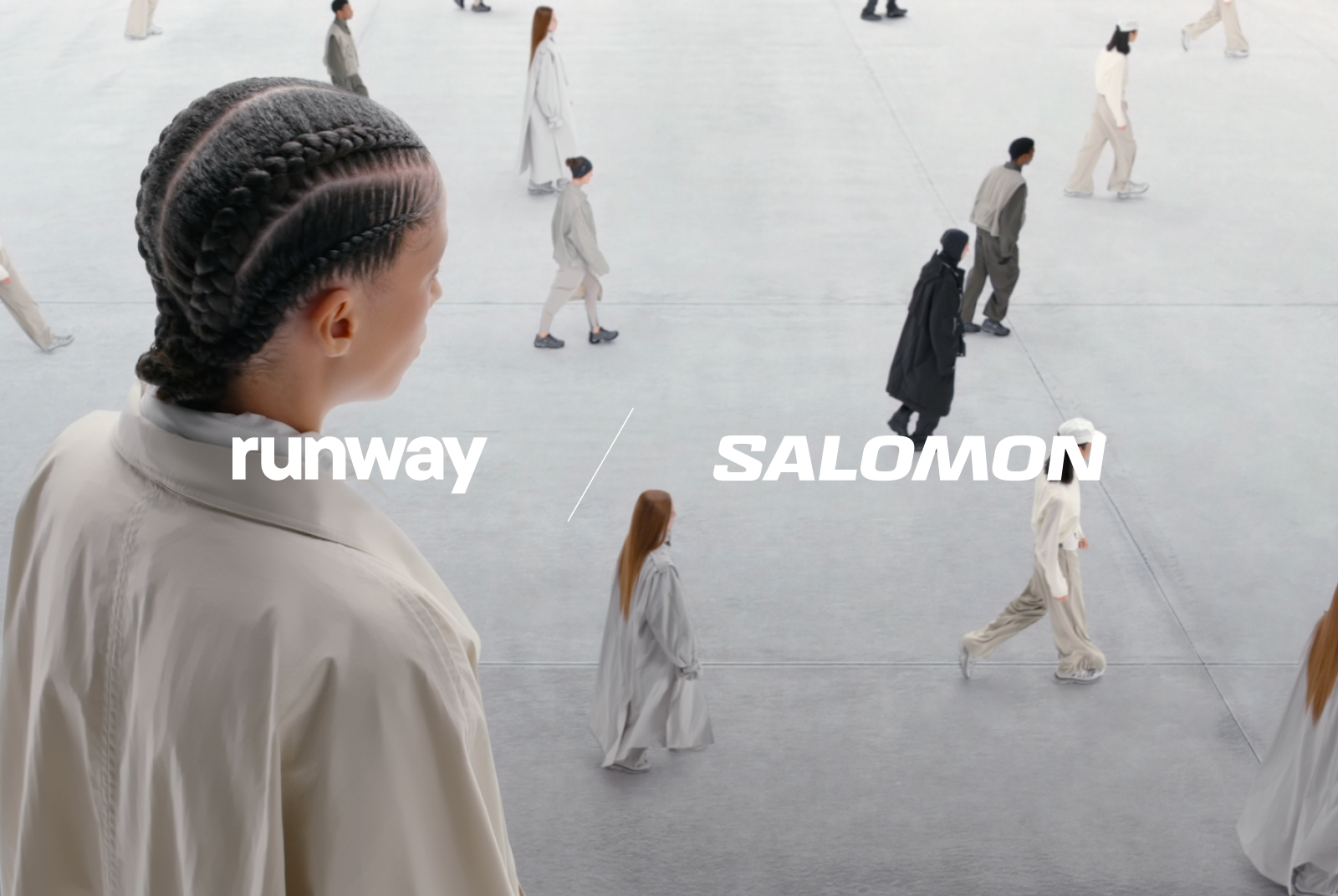
Founded in September 2023, Paris-based Unveil is a creative studio using artificial intelligence to expand human creativity, with clients including Balenciaga, Coty, Puma and Moet & Chandon, that built its identity around a medium most studios are still trying to figure out. Co-founders Tom-Jacques Perret and Alexis Foucault have been Runway users for years – in this discussion, they walk us through their creative process for Salomon’s latest global brand campaign, a hybrid production combining live action and artificial intelligence that launched during the opening of the Milan Olympic Games and has since been rolled out worldwide. The film’s universe was also extended into a print campaign displayed across many Salomon stores.
You don’t come from traditional filmmaking or advertising backgrounds. Tell us about how Unveil came about.
We were not directors before, not photographers, not CGI artists. I was already working in generative art, like algorithm-driven images and fractal mathematics. When AI came, it felt like the same process, but suddenly applicable to any subject or context. It was an evolution of my practice.
What struck us was that the only real limit became imagination. Budget and technique stopped being creative constraints. What was previously inaccessible to us—making films, making images—became instantly possible without 10 years of craft.
And because we didn't come from those traditional backgrounds, there was no difficult switch to make. A CGI artist or photographer needs to consider how AI fits into their existing workflows, but for us, there was nothing to unlearn.
You've described your process as deliberately embracing randomness and chaos. How does that actually work in practice?
We use serendipity as a core part of the process. We don't come to a project with a perfect mental picture of what we want – we have ingredients: a story to tell, a mood, an atmosphere. Then we let the idea be nourished through dialogue between us and the machine. We like to be surprised along the way.
A lot of our portfolio is made of happy accidents that elevate the production. We begin in a pool of chaos, then we curate and filter to regain control toward the end. You still need to match the high expectations of deliverables and clients, and they're used to working with strong references. We often say: give us some freedom to show you something else.
Walk us through how the Salomon campaign came together.
The initial concept was a heroine embodying Salomon as a person, moving through different worlds. It was a story about future innovation and a sense of journey.
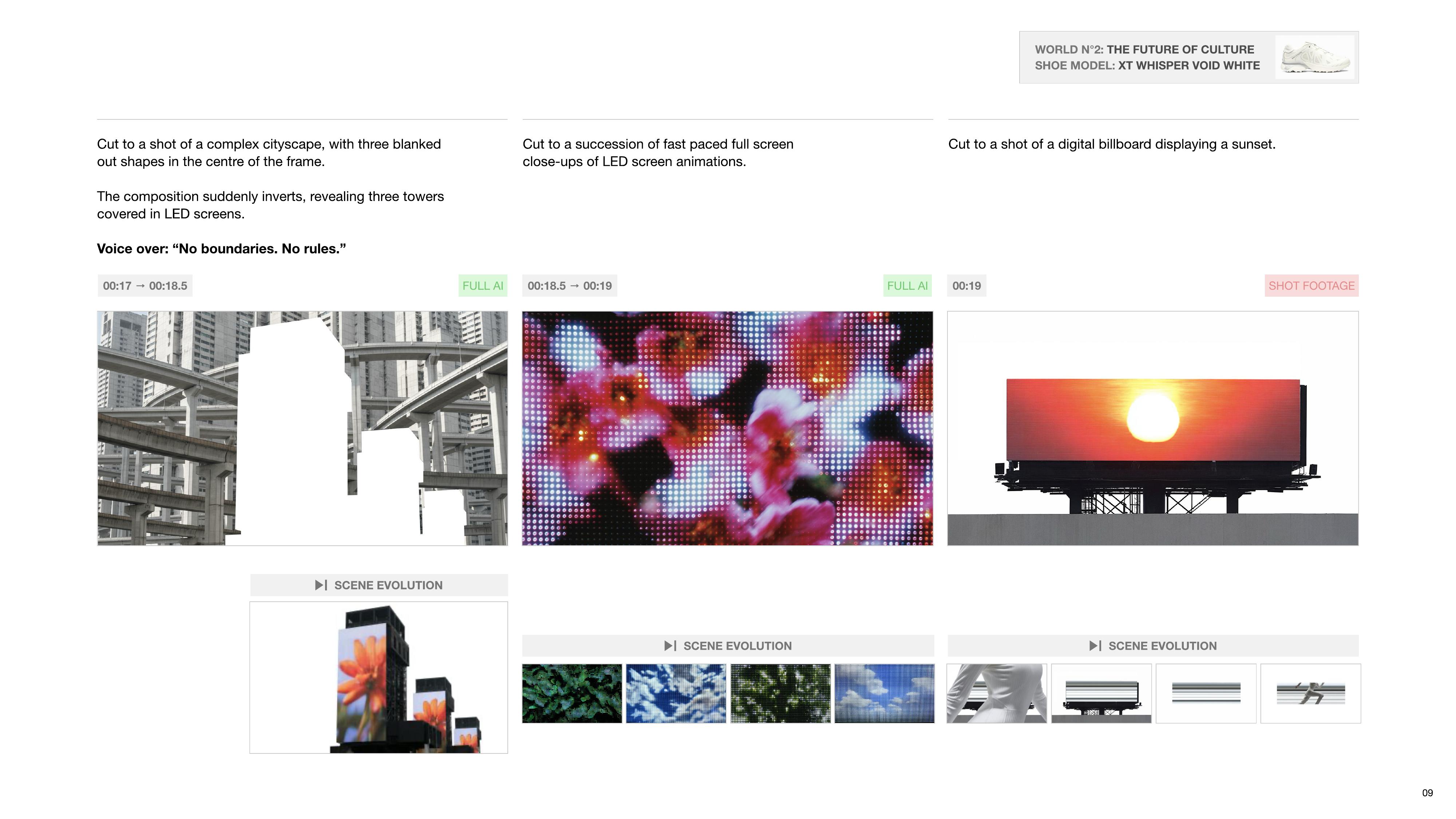
We had to pitch our vision of the film, and we concepted and storyboarded everything with Runway. The client, and their agency team, could see exactly how the film would look before we shot a single moment of it – what we ultimately delivered was very close to that initial treatment.
That process of being able to quickly mock up ideas rather than just describe them was clearly an element that got us the job. We also made a strategic decision to propose a hybrid approach: a human protagonist shot in live action, with environments generated in AI.
Why Runway specifically for this project?
We've been Runway users since Gen:48, so it was already in our heads. There’s certain tools and capabilities that we can’t get elsewhere. Aleph in particular lets you quickly swap an object or replace an environment from an existing video. That was essential for our hybrid approach, where we were working with both stills and video, and wanted this shape-shifting effect throughout the film. And now that Runway has multiple models and tools in one place, it’s a platform we can do almost everything in, even as we jump from model to model for different looks and use cases.
Describe the actual production workflow – how did the AI and live-action sides fit together?
The first step was using Runway to create the full storyboard, which was 30 shots, all with precise angles and framing. That gave us a base environment and exact camera angles we could overlay with pre-visualization on the shoot.
Then we had two days of shooting near Paris with a team of 60: technicians, stylists, models, lighting crew, DOP. We'd been working on our computers, and now suddenly the thing was real. The casting agency actually found a model that looked almost exactly like the one we had concepted with Runway. We had a bit of a full-circle moment meeting this person in real life – the features, the face, were recognizable from when we'd generated someone similar.
On set, being able to mock up in real time—swapping an environment, adjusting a compositional element—was incredibly useful. Even for 100% live-action productions, AI as a pre-production tool is unmatched.
Can you give a sense of what this production would have cost in time and resources using a traditional approach?
The budget for the campaign was fixed, but because we were working with AI, we had no creative limit. A CGI approach or a fully live-action equivalent would have taken twice as long – we would have needed a CGI team of 10 or 15 people. With AI, we could propose something significantly better than anyone else pitching at the same budget, because the techniques we were using didn't constrain us.
You're now working with Balenciaga, Oakley and other international brands. What pattern are you seeing in how they want to work?
With Salomon, what was really new was the scale of the campaign and the hybrid approach. We went for a green-screen setup: real humans shot in live action, placed inside AI-generated environments. They were honestly pretty bold to push AI that far for a global campaign, and in the end, the balance between traditional production and AI felt just right.
With Balenciaga, it’s different. For now it’s mostly social-first content, but from our chats with them, it feels like it’s just the start.
With Oakley, it’s again a totally different setup. We can’t share details yet, but the way we’re working together is very new and it genuinely feels like a “next big AI thing”. We can’t wait for it to be public.
What's your advice to brands and creatives who are thinking about AI but haven't committed?
Give it a try. In the end, the eye of the artist remains the most important thing. If you give a camera to an incredible photographer, you get incredible results. It's exactly the same with AI.
There is a new kind of creativity these tools are capable of. I hear a lot of negative reactions to AI, but you can create poetry with AI. If you have emotions to share and stories to tell, you have an incredible medium where you have no limits to your production. It changed everything for us, and that's really possible for anyone who tries it.